I have walked into plenty of Clifton basements in January where the trouble started months earlier, in a quiet corner nobody looked at in the fall. A pipe along a cold wall, a hose still hooked up outside, a shutoff valve nobody had touched in years. None of it looked urgent in October. That is the point of this post. Winterizing is the work you do while everything still works, so a cold snap finds a house that is ready for it.
This is a prevention post, room by room, for a homeowner who wants to do the sensible jobs before winter and know when to call for the rest. If a pipe has already frozen, that is a different job, and I link to it below.
When to do this work in Clifton
Do not wait for a forecast that sounds cold enough. Frost timing moves from year to year, and a single cold night can arrive before you feel ready.
NOAA 1991 to 2020 medians summarized for northeast and metro New Jersey stations put first fall frost at Oct 28 to Nov 10. A Clifton listing based on the same NOAA normals, reported by app.com, puts Clifton first fall frost at Oct 22, and notes that date uses a 30 percent probability threshold, so it is a planning tool, not a promise. Read those two together and the message is plain: aim to finish this work before late October. If you are reading this after that window, do it this weekend anyway. Late work still helps.
Start outside: hoses, faucets, and lines that drain
Outside work comes first because it is work close to the cold, and because it is easy to forget until the first hard night.
- Unhook every garden hose. Store the hose where it will not sit full of water. A hose left hooked up can hold water against the faucet and the line behind it.
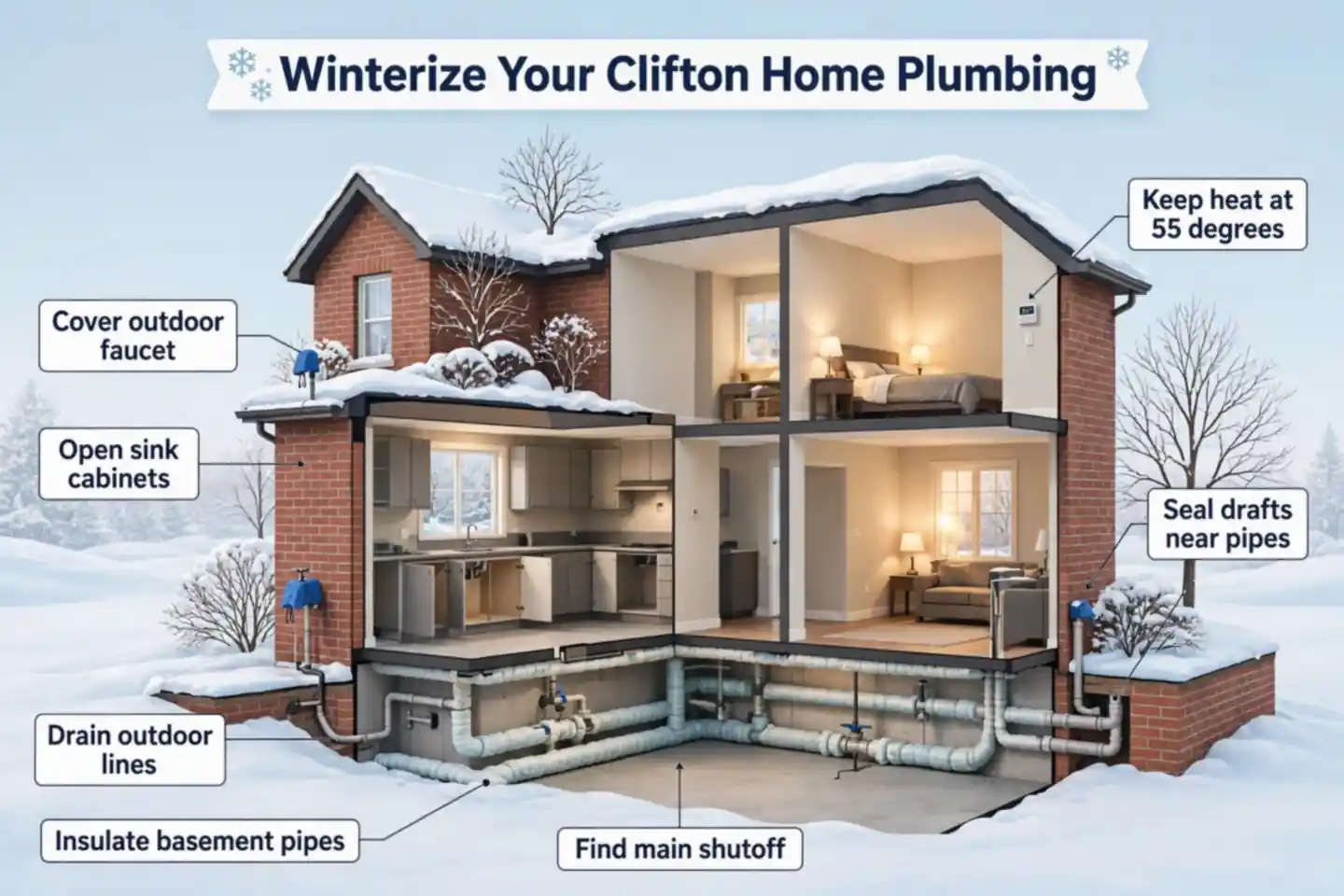
- Find the inside shutoff for each outdoor faucet, if your house has one. Close it. Then open the outdoor faucet and let the line drain. Leave the outdoor faucet open a crack so water left in the line has room to move as it cools.
- Put an insulated cover over each outdoor faucet after it has drained. The cover is not a substitute for draining. Draining comes first, the cover comes second.
- If you have a sprinkler system or any outdoor line that runs to a shed or a yard tap, shut that line off at its inside valve and drain it the same way. Do not leave an outdoor line charged through winter just because it is out of sight.
Walk around the house once after you finish and look at each faucet again. A cover on a faucet that still has a hose hooked up behind it is a job half done.
Basement: meter, shutoff, and pipes you can reach
The basement is where I start on a winter check in an older Clifton home, because that is where the water comes in and where the cold runs usually sit.
Find your main shutoff valve and your water meter. They are often near where the main line enters through the basement wall. Turn the shutoff closed, then open it again, on a calm day, not during a leak. If it sticks, will not turn fully, or drips when you move it, note it and get it looked at before winter. A shutoff that will not turn is not a safety device. It is a decoration.
Next, look at every pipe you can reach in the basement. Insulate the runs in unheated space first. The United States Department of Energy Building America guidance lists closed cell foam pipe sleeves, fiberglass or mineral wool sleeves or wraps, and insulating tape as pipe insulation options, and it points to ventilated crawl spaces, uninsulated basements, and sinks along exterior walls as places where insulation helps protect pipes from freezing.
A few details from that same guidance matter in a real basement:
- Match the sleeve to the pipe. Match the sleeve inner diameter to the pipe outer diameter, so the sleeve sits snug with no bare gaps at joints and bends.
- Cover hot and cold lines in unheated space. A cold line can freeze just as a hot line can, and a hot line loses heat along an unheated run. The Department of Energy, cited by Consumer Reports, notes insulated hot water pipes can keep water 2 to 4 degrees higher than uninsulated pipes.
- Mind the flue. Keep insulation at least 6 inches from the flue of a gas water heater. If pipes sit within 8 inches of the flue, the guidance recommends fiberglass or mineral wool pipe wrap there.
- Seal the drafts that reach the pipes. Caulk or spray foam where a pipe passes through an exterior wall or the foundation, and where cold air pours in around a sill or a rim joist. Insulation slows heat loss from a pipe. It does not stop a direct draft from reaching bare pipe at a gap.
While you are down there, look at the meter area and the wall where the main enters. A broken or loose meter pit lid, a cracked basement window, or an open vent near a pipe run lets cold air straight to the line. Fix the opening, then insulate the pipe.
Kitchen and baths: sinks on outside walls
Pipes under a kitchen or bath sink on an exterior wall sit in a small cold box every winter. The room feels warm. The cabinet does not.
Open the cabinet doors on the cold nights so warm room air can reach the pipes. This matters where the sink sits against an outside wall. Keep cleaning products and anything a child or pet could reach out of an open cabinet, and close the doors again in the morning.
Insulate any pipe you can reach under those sinks, the same way you did in the basement. Check the wall behind the sink for a draft, especially where supply lines pass through. A small gap there can undo a sleeve further down the line.
If a sink has a history of slow drains or odd noises, do not fold that into a winter job and hope cold weather ignores it. Get it looked at on its own terms. Winterizing protects a sound system. It does not repair one.
Unheated rooms, garage, attic, and laundry
Walk the house with one question in mind: where does a pipe run through a space that gets no heat?
That list usually includes a garage with a laundry sink or a hose tap, an attic with a line to a bath above, a crawl space, and a laundry room on an exterior wall. Insulate those runs, seal the gaps where they pass through walls, and close crawl space vents and doors that let cold air pour in.
In a garage, keep the door closed on cold nights if a water line runs through the space. A garage door left open turns a sheltered run into an outdoor run. In an attic, do not bury a pipe under loose insulation and call it done. The pipe still needs its own sleeve, and the sleeve still needs to fit with no gaps.
If a room has no heat and no plumbing, it still matters when it shares a wall with a pipe run. Cold moves through that wall. Seal the wall penetrations on the warm side too, so the pipe is not sitting in a draft path.
Heat habits while you are home, and while you are away
Insulation buys time. Heat is what keeps a pipe above freezing through a long cold stretch. Keep heat steady through the house, including rooms you rarely use, when cold weather sets in. A room you shut off to save heat can hold a pipe that freezes while the rest of the house feels fine.
Water utilities commonly advise keeping heat at 55 degrees or above when you will be away from home. Follow that floor if you travel in winter, and ask someone you trust to check the house. A quick check can catch a heating failure before it becomes a pipe failure.
On the cold nights, let a faucet fed by an exposed line run at a slow drip. Moving water resists freezing, and an open faucet gives expanding ice somewhere to go. Drip the faucets on exterior walls first. Turn the drip off when the cold snap passes.
If you will be away for a long stretch in winter, shutting off the main water valve and draining the lines by opening the lowest faucets is a stronger step than heat alone. A drained system has no water in it to freeze. Talk through that choice before you leave, because a drained system also means no water for heat related equipment that needs it, and the water heater needs its own shutoff steps. If you are unsure, call and ask before you drain anything.
If a pipe has already frozen
This post is about prevention. If you turn on a faucet on a cold morning and nothing comes out, stop and treat it as a repair, not a winterizing job.
Open the faucet that gives no water, so pressure has somewhere to go as ice melts. Do not thaw a pipe with an open flame. If the pipe has already split, shut off the main water valve right away and call. For the repair side of this, including what a safe thaw looks like, see our frozen pipe repair page in Clifton: frozen pipe repair in Clifton
Estimates for a visible repair are free. Hidden leak detection is $150 to $400.
NJ requires plumbing work to be done by, or under the supervision of, a licensed Master Plumber.
A walkthrough you can do in one afternoon
- Outside: unhook hoses, shut off and drain outdoor faucets, fit insulated covers.
- Basement: find and test the main shutoff, find the meter, insulate reachable runs, seal wall gaps, mind the flue clearances above.
- Kitchen and baths: insulate pipes under sinks on exterior walls, plan to open cabinet doors on the cold nights.
- Unheated spaces: insulate garage, attic, crawl space, and laundry runs, close vents and doors that feed cold air to pipes.
- Heat: keep heat steady, keep it at 55 degrees or above while away, drip exposed faucets on the cold nights.
- Leaving for a long stretch: consider shutting off the main and draining lines, and ask first if you are unsure about the water heater steps.
Do that walk once before late October, then repeat the outside and basement checks after any stretch of hard cold. Winterizing is not a single afternoon that lasts all winter. It is a routine that holds up because you look at the same spots again.
If you want a second pair of eyes on the basement runs, the shutoff, or a line you cannot reach, call (862) 416-0004. A visit before the first freeze is a calmer visit than a call during one.
Frequently asked questions
When should I winterize my plumbing in Clifton?
Finish before late October. NOAA 1991 to 2020 medians summarized for northeast and metro New Jersey stations put first fall frost at Oct 28 to Nov 10, and a Clifton listing based on the same normals puts Clifton first fall frost at Oct 22. Treat those dates as planning guides, not promises, and do the work as soon as you can in the fall.
Where should I insulate pipes first?
Start with pipes in unheated space: basement, crawl space, attic, and garage, plus any pipe along an exterior wall and any pipe under a sink on an exterior wall. Use foam sleeves, fiberglass or mineral wool wraps, or insulating tape, matched to the pipe size, with no gaps at joints and bends.
How do I drain an outdoor faucet line?
Close the inside shutoff for that faucet, if your house has one. Open the outdoor faucet and let the line drain. Leave the outdoor faucet open a crack, then fit an insulated cover. Unhook the garden hose first, so water is not held against the faucet.
Should I keep the heat on while I am away in winter?
Yes. Water utilities commonly advise keeping heat at 55 degrees or above when you will be away. Ask someone you trust to check the house during your trip. For a long winter absence, shutting off the main and draining lines is a stronger step, and you should ask first if you are unsure about the water heater steps.
What should I do if a faucet gives no water on a cold morning?
Open that faucet, so pressure has somewhere to go as ice melts, and call rather than forcing a thaw yourself. Do not use an open flame on a pipe. If a pipe has split, shut off the main water valve right away and call (862) 416-0004. Our frozen pipe repair page in Clifton covers the repair side: frozen pipe repair in Clifton
Sources checked for this post
- NOAA 1991 to 2020 frost medians for New Jersey regions, summarized at https://www.sowsprout.com/frost-dates/
- Clifton first fall frost listing at Oct 22, reported at https://www.app.com/story/weather/2026/10/17/the-first-frost-dates-2026-new-jersey/92310485007/
- United States Department of Energy Building America pipe insulation guidance at https://basc.pnnl.gov/diy-guides/insulate-hot-water-pipes
- Department of Energy note on insulated hot water pipes keeping water 2 to 4 degrees higher, cited at https://www.consumerreports.org/cro/news/2010/02/weekend-project-insulate-hot-water-pipes-to-cut-down-on-heat-loss/index.htm