
It is a cold January morning in Clifton. You turn on the kitchen tap and get nothing. No drip, no sputter, just silence. Down the street, a neighbor in a newer house has water like always. That difference is not bad luck. In Clifton, it is usually the age of the house doing the talking.
Here is the number that explains most of it. The median Clifton home was built in 1951, according to U.S. Census Bureau American Community Survey figures. That means half of Clifton homes are older than that and half are newer. Look at the decades and the picture gets sharper: 31.2% of homes were built in 1939 or earlier, 15.4% in the 1940s, and 22.5% in the 1950s. Add those up and you get 69.1% of Clifton homes built before 1960. Roughly 7 in 10 homes in this city went up before modern insulation and pipe routing were standard practice.
So when a cold snap hits, Clifton does not freeze evenly. The homes that freeze first tend to share the same traits: pipe runs in cold places, thin or missing insulation, and pipe material that has had decades to age. If you own one of these homes, it helps to know which of those traits your house has, because each one points to a different fix.
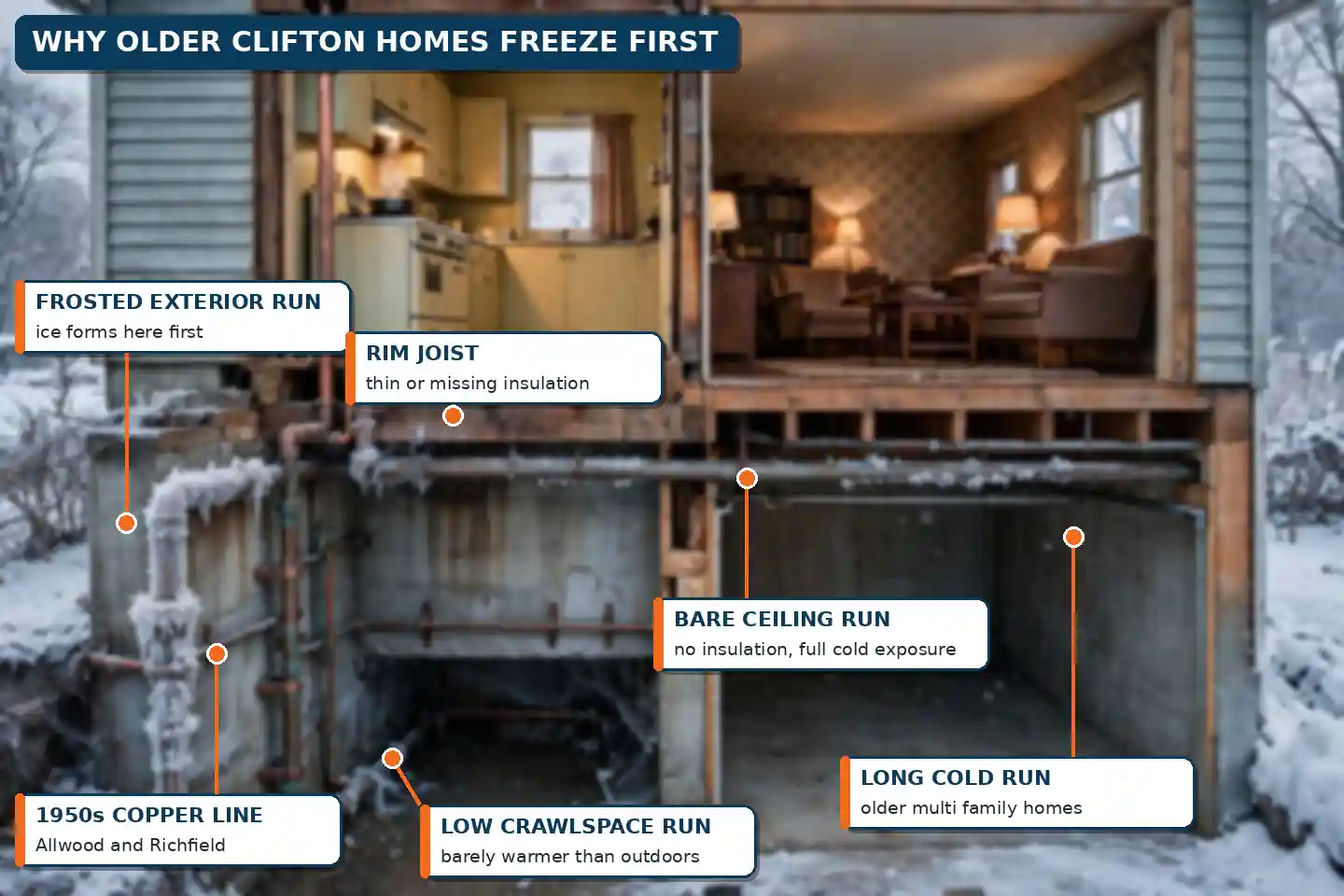
It is not just the cold. It is where the pipe sits.
A pipe does not burst because ice pushes outward on the walls. That is the common picture, and building science says it is mostly wrong. Water expands about 9% when it freezes. As ice forms from the outside of the pipe inward, it traps liquid water between the ice plug and a closed faucet. Liquid water barely compresses, so pressure in that trapped section climbs fast, and that pressure is what splits the pipe.
That is why two houses on the same street can have very different nights. The house with a supply line in a warm interior wall sleeps through the cold snap. The house with the same line running along an outside wall, through an unheated crawlspace, or across a cold garage ceiling wakes up to no water. The cold matters, but the location of the pipe decides whether the cold can reach it long enough to freeze it solid.
It is also why a frozen pipe can look fine and still be trouble. The split often sits in the frozen section itself, and you may not see it until the ice melts and water starts moving again. A pipe that froze once deserves a careful look after it thaws, even if everything seems back to normal.
Two eras of Clifton plumbing, two different freeze stories
Clifton was not built all at once, and its pipes tell that story. Two patterns cover most of the older homes we see.
Allwood and Richfield: 1950s copper. The colonials and Cape Cods in Allwood and Richfield mostly went up in the 1950s, and they mostly run copper supply lines. Copper is a solid pipe, and it handles decades of service. But these lines were routed the way builders routed them in the 1950s: through cold chases, along outside walls, and across uninsulated basement ceilings. A copper line in a cold spot freezes the same way any line does, and a 1950s run has now seen decades of winters. When we find a freeze in one of these homes, it is often in the same kind of spot: an exterior wall run or a basement ceiling run that never got insulation when the house was finished or remodeled.
Athenia and Botany Village: older multi family galvanized. The older multi family homes in Athenia and Botany Village are a different story. Many of them still carry galvanized steel lines. Galvanized pipe rusts from the inside over decades, and that rust narrows the pipe. A narrowed line still carries water on a normal day, but it has less room to spare. When a partial freeze starts, flow chokes off fast, and the whole run can freeze solid sooner than a full sized line would. These buildings also tend to have long runs through unheated common areas, plus additions where the insulation is thin. So the freeze risk here comes from two directions at once: older narrowed pipe and longer cold runs.
Neither story is a reason to panic. Both are reasons to know what is in your walls before the cold finds it for you.
The cold spots in an older Clifton basement
If you own an older Clifton home, your basement tells you most of what you need to know. Walk it slowly on a cold day and look for these spots:
Rim joists. These are the framing boards where your house meets its foundation, right at the top of the basement wall. In older homes the insulation here is often thin, missing, or fallen out of place. Supply lines that pass through or near rim joists sit in some of the coldest air in the house.
Exterior wall runs. Any pipe that runs along or inside an outside wall is exposed to cold from one side and often has little insulation between the pipe and the masonry or siding. Kitchen and bathroom lines on outside walls are the usual suspects.
Uninsulated basement runs. In many older Clifton basements, supply lines run bare across the ceiling or along the wall. When the basement itself is unheated, those lines sit at basement temperature all night, and a long cold stretch pulls that temperature down.
Crawlspaces and garages. Pipes that pass through a crawlspace or a garage ceiling live in spaces that are barely warmer than outdoors. A garage door left open on a cold night can drop the temperature around those lines fast.
Additions. A room added years after the house was built sometimes has plumbing run through a space that was never insulated to the same standard as the rest of the house. The joint between the old house and the addition is worth a close look.
Finished basements. A finished ceiling can hide all of the above. If your basement is finished and a line above that ceiling freezes, you may not see frost or feel a draft. The first sign is often a faucet that stops working, or a stain that shows up after a thaw.
You do not need tools for this walkthrough. You need a flashlight, a cold day, and a note of which runs feel cold to the touch and which faucets are the first to slow down when the temperature drops.
What actually helps, and what to skip
The fixes follow the cause, so start with the cause you found.
If the problem is a bare run in a cold basement, insulation on that run is the direct answer. Foam sleeves and wrap belong on the cold runs first, not spread thin across every pipe in the house. Start with exterior wall runs, rim joist crossings, and crawlspace sections.
If the problem is a drafty rim joist bay, sealing and insulating that bay helps the pipe and the room above it. A pipe sitting in a draft will freeze even with a sleeve on it if cold air keeps pouring past.
If the problem is a line that freezes in the same spot every winter, rerouting that section through a warmer part of the house is worth discussing. Insulation slows heat loss; it does not create heat. A line in a space that stays below freezing for days will eventually freeze no matter how it is wrapped. Moving it is sometimes the honest answer, and it is a smaller job than most homeowners expect when the run is in an open basement.
What to skip: thawing a frozen line with an open flame. No torch, no heat gun on high, no space heater pressed against the pipe. Gentle, even heat is the safe way, and if you cannot see the full frozen section, that is a good time to call rather than guess. If you walk your basement and find a run you are unsure about, call (862) 416-0004 and describe what you found before the next cold stretch arrives.
When repair stops making sense
One frozen section in an otherwise sound system is a repair. Insulate it, reroute it if needed, and move on. But there is a point where repeated repairs stop being the smart move, and older Clifton homes reach it in a recognizable way.
If the same galvanized system freezes, clogs with rust, and loses pressure again and again, you are treating symptoms of a system that is wearing out everywhere at once. If a 1950s copper system keeps splitting at different joints each winter, the pattern is telling you something too. That is when replacement enters the conversation: not as an upsell, but as the option that ends the cycle of winter emergencies. Our pipe replacement page walks through how that decision is made, and we will tell you honestly when a repair is still the right call.
What it costs to find out
If you can see the problem, a visible repair estimate is free. If the problem is hidden, for example a leak behind a wall or under a floor that only shows up after a thaw, hidden leak detection is a paid service at $150 to $400. Either way you get the price in writing before any work starts, so there is no surprise at the end of the visit.
NJ requires plumbing work to be done by, or under the supervision of, a licensed Master Plumber.
If a pipe has already frozen, or if you walked your basement just now and recognized your house in this post, call (862) 416-0004. We serve homeowners across Clifton, 07011 to 07014. If you need help with a frozen line, our frozen pipe repair page explains how a thaw visit works. The call is the whole process. There is no form to fill out.
Frequently asked questions
Why does my older Clifton home freeze when newer homes on my street do not?
Because of where your pipes run and how your house was insulated when it was built. Roughly 7 in 10 Clifton homes were built before 1960, when pipes commonly ran along exterior walls and through unheated basements with little insulation. A newer home on the same street usually has its lines routed through warmer spaces with insulation that meets modern practice. Same cold snap, very different exposure.
Is copper or galvanized pipe more likely to freeze?
Either one can freeze. Location and exposure matter more than material. The difference is what happens next. A galvanized line narrowed by decades of internal rust has less room to spare, so a partial freeze chokes flow faster and the run can freeze solid sooner. A copper line in a cold spot freezes just the same, but it usually keeps full flow until the ice plug forms. So the question to ask is not only what material your pipes are, but where they run.
Where should I look first in my basement?
Start at the rim joists, the framing boards where the house meets the foundation at the top of the basement wall. Then follow any supply line that runs along an exterior wall, across an uninsulated ceiling, or through a crawlspace or garage. Those are the cold spots in most older Clifton homes. Note which runs feel cold to the touch and which faucets slow down first in a cold stretch, and you have a map of your risk.
If a pipe froze once, will it freeze again?
Usually yes, in the same spot, unless something about that spot changes. Insulation, draft sealing at the rim joist, or rerouting the section through a warmer space are what break the pattern. A pipe that froze once also deserves a check after it thaws, because the split that causes the real damage often only shows up when the ice melts and water moves again.
Does a frozen pipe always burst?
No. A freeze becomes a burst when ice traps liquid water between the plug and a closed faucet and pressure in that trapped section climbs until the pipe splits. That is why leaving the affected faucet open a trickle matters: it gives water and pressure somewhere to go. If a line has frozen, do not just wait for the thaw and assume all is well. Check the whole run for splits once water is flowing again.
Should I repair or replace old lines that keep freezing?
Repair the first freeze, and fix the cause behind it with insulation or a reroute. If freezes, rust narrowing, and pressure loss keep coming back across the same system, replacement usually costs less over time than repeated emergency visits. Our pipe replacement page covers how that call is made. If a line is frozen right now, start with our frozen pipe repair page.
Sources: U.S. Census Bureau, American Community Survey 2020 to 2024, table B25035 (median year built 1951) via BestNeighborhood; Census based decade shares for Clifton via Point2Homes (31.2% built in 1939 or earlier, 15.4% in the 1940s, 22.5% in the 1950s; pre 1960 total of 69.1% is the sum of those three shares). Freeze mechanism (water expands about 9% on freezing; trapped liquid pressure, not ice pushing on walls, splits the pipe) per Penn State Earth 111 water science course material (ice volume a little over 9% greater than liquid water; density 0.99984 grams per cubic centimeter liquid at freezing vs 0.9168 grams per cubic centimeter ice).