If you are watching a forecast slide toward freezing and wondering whether your pipes will make it through the night, you want a number. I understand that. Here is the honest answer from a plumber who has thawed pipes in Clifton homes: there is no single number that tells you your pipes will freeze tonight, and anyone who gives you one without asking where your pipes run is guessing.
That is not a dodge. It is how freezing works. The water inside a pipe has to reach freezing before ice can form, and how fast that happens depends on how long the cold lasts, how much wind and draft reach the pipe, how much insulation sits between the pipe and the cold, and where the pipe runs in your house. Two homes on the same street, in the same cold snap, can have very different nights. One wakes up to running water. The other wakes up to a dead faucet.
This post gives you the numbers that do mean something, explains what each one really means, and walks through what actually puts a Clifton basement run at risk. If you already have a dead faucet this morning, skip to the frozen pipe page linked at the end of this post and call (862) 416-0004.
The short answer: watch conditions, not one reading
A pipe does not freeze the moment the outdoor thermometer touches freezing. It freezes when the water inside it loses enough heat to turn to ice, and that takes time. A brief dip below freezing on a calm night, with the heat running and the pipes inside insulated walls, usually passes without trouble. A long stretch of deep cold, with wind finding its way into an unheated basement corner, is a different story.
So instead of asking “what number freezes pipes,” ask four questions about your own home:
- How long will it stay below freezing?
- Can wind or a draft reach the pipe?
- Is the pipe insulated, and is the space around it heated?
- Where does the pipe run?
Those four answers tell you more than any single forecast low ever will.
Three numbers worth knowing, and what each one really means
32 degrees: the point where water freezes
Water freezes at 32 degrees Fahrenheit. That is a fact about water, not a promise about your plumbing. Your pipe is not a glass of water sitting on a porch rail. It sits inside walls, under floors, or in a basement, surrounded by building material and house heat that slow the cold down. The water inside has to cool all the way to 32 degrees before ice starts to form, and on a mild freezing night it may never get there.
Think of 32 degrees as the starting line, not the finish line. Below it, freezing becomes possible. It does not become certain.
20 degrees: an alert threshold from building research, not a freeze promise
Researchers at the Building Research Council at the University of Illinois studied when uninsulated water pipes in unheated spaces begin to freeze, and their work gave rise to a widely used alert threshold of about 20 degrees Fahrenheit. Below that point, uninsulated pipes in unheated spaces are far more likely to freeze. The United States Department of Energy uses the same neighborhood of temperature when it warns that concern about freezing pipes rises when temperatures drop to 20 degrees or below.
Read that carefully, because the wording matters. It is an alert threshold. It means “take this cold seriously and check your exposed pipes,” not “every pipe freezes at 20 degrees” and not “every pipe is safe above 20 degrees.” A drafty, uninsulated run can freeze at a warmer reading if cold air blows straight across it for hours. A well insulated run inside a heated part of the house can ride out a much colder night without trouble. The threshold is a warning light, not a tripwire.
That distinction is the whole point of this post. If someone tells you pipes freeze at exactly one temperature, they are selling certainty that the research does not support.
55 degrees: the Red Cross number for a house left empty
The American Red Cross advises that if you leave home during cold weather, you leave the heat on, set to a temperature no lower than 55 degrees Fahrenheit. That number is about the house, not the weather outside. It keeps the air around your indoor pipes warm enough that a cold snap outside does not drag the water inside down to freezing while nobody is home to notice a dead faucet.
If you are home, the Red Cross advice is simpler: keep the thermostat at the same setting day and night during very cold weather, rather than dropping it low overnight. A slightly higher heating bill is a small price next to a burst pipe, and a steady temperature means the cold never gets a long, quiet stretch to work on your pipes while the house cools down.
Four things that matter more than the forecast low
1. Time: how long the cold lasts
Time is the factor homeowners underestimate most. Freezing is a slow process. Heat leaves the water gradually, through the pipe wall, through insulation, and into cold air. A few hours below freezing may not be enough to pull a pipe all the way down to 32 degrees, especially if the pipe sits inside a heated space. An overnight stretch, or cold that holds through a full day and into a second night, gives the cold time to win. That is why the risky nights in the Passaic area tend to be the ones where the cold does not lift during the day, not the ones with a single cold hour before dawn.
2. Wind and drafts: cold air moving across a pipe
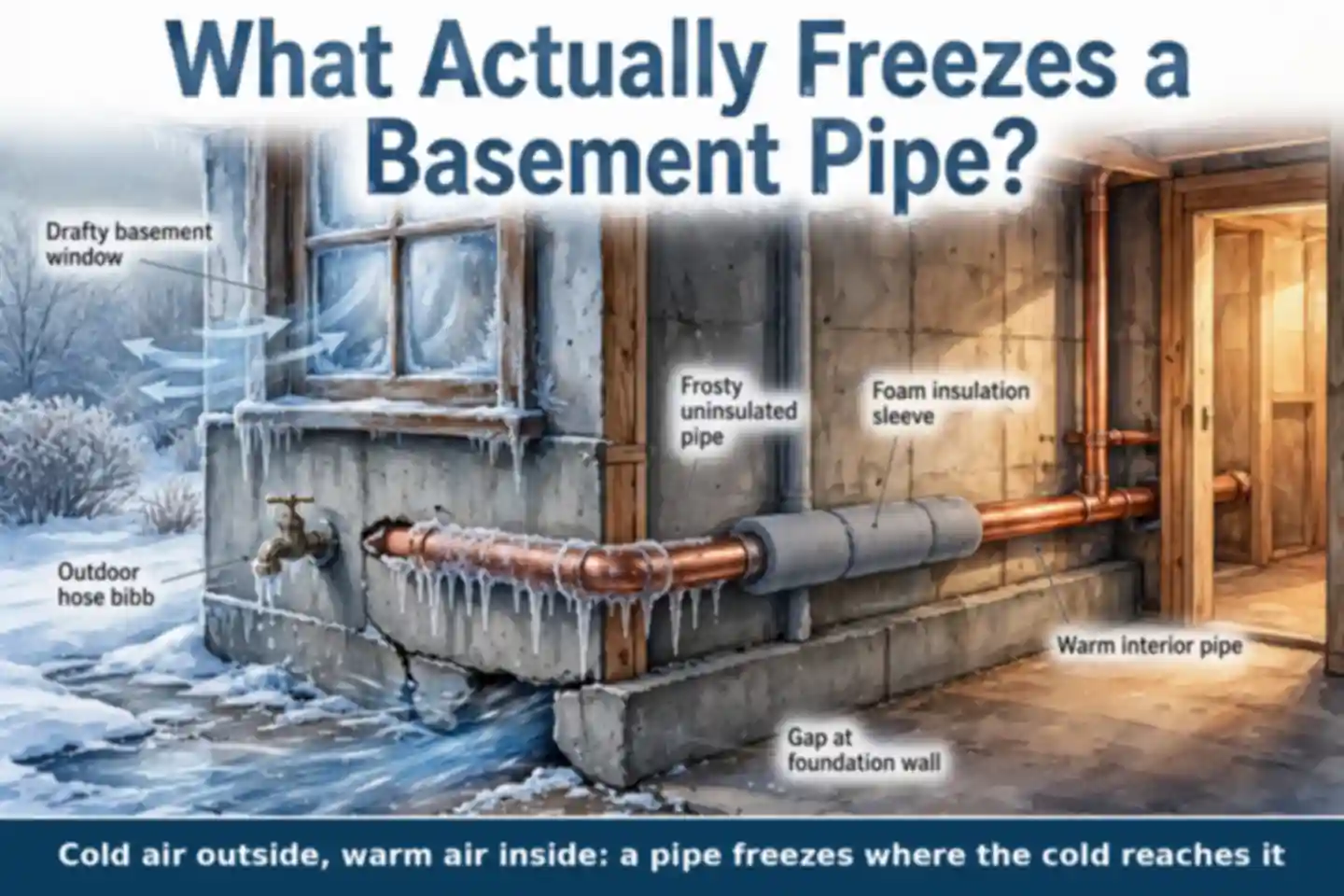
Still cold air is one thing. Moving cold air is another. Wind strips away the thin layer of slightly warmer air around a pipe and replaces it with fresh cold air, so the pipe loses heat faster. A draft through a basement vent, a gap where a pipe enters through a foundation wall, or a garage door that does not seal can do the same thing indoors. This is why two identical pipes can behave differently: one in a sealed, still corner stays liquid, while one in a drafty corner ices up.
A related point causes a lot of confusion, so let me settle it plainly. The wind chill number on your weather app is about how fast exposed skin loses heat. It is not the temperature your pipes will reach. The National Oceanic and Atmospheric Administration states this directly: inanimate objects such as water pipes will not cool below the actual air temperature, no matter how low the wind chill number goes. If the air is minus 5 degrees and the wind chill is minus 31 degrees, your pipe will not drop to minus 31 degrees. But the wind can still push it toward minus 5 degrees faster than still air would. Wind speeds the cooling. It does not change the floor.
3. Insulation: it buys time, it does not make heat
Pipe insulation works like a coat. It slows heat loss. It does not create heat. A foam sleeve on a basement run gives the water inside more time before it reaches freezing, and on many nights that extra time is all you need. But insulation on its own, in a space that stays below freezing long enough, will eventually lose the race. Insulation plus some heat in the space, or insulation plus moving water, is a far stronger combination than insulation alone.
Check the insulation you already have, too. A sleeve that slipped off, a gap at an elbow, or a section left bare where a pipe turns a corner is often where the freeze starts. Cold finds the weak spot.
4. Location: where the pipe runs decides almost everything
The pipes that freeze are rarely the ones in the middle of a heated house. The American Red Cross lists the usual trouble spots, and they match what we see in Clifton: outdoor hose bibbs, swimming pool and sprinkler supply lines, water supply pipes in unheated interior areas such as basements, crawl spaces, attics, and garages, and pipes that run against exterior walls with little or no insulation.
A basement run deserves a close look in a Clifton home. Basements here are often only partly finished, and a run along an exterior foundation wall, near a vent or a window that does not close tight, sits in cold house air. Add a line that nobody uses much, so the water inside sits still for days, and you have the classic setup: still water, cold air, no insulation, and a long cold night to do the work.
What actually puts a Clifton basement run at risk
Walk your basement before the cold arrives and look for this combination. One item on its own may be fine. Several together mean you should act before the forecast turns.
A run along an exterior foundation wall, rather than through the middle of the house. A vent, window, or gap in the foundation near the run that lets cold air in. Bare pipe, or insulation with gaps at elbows and joints. A line that serves a fixture nobody uses often, so the water sits still. A basement that gets little or no heat, or a thermostat set low overnight and while you are away. An outdoor hose still connected to a hose bibb, trapping water in the line.
If you recognize your basement in that list, the fix is not complicated: insulate the exposed runs, seal the drafts you can reach, disconnect outdoor hoses before winter, and let a faucet served by an exposed pipe drip cold water on very cold nights. Running water, even at a trickle, helps prevent freezing, because moving water is harder to freeze than still water. Open cabinet doors under sinks on exterior walls so warm house air can reach those pipes. And if you travel, leave the heat at 55 degrees or higher, as the Red Cross advises.
What to do on a very cold night
When the forecast calls for a long stretch below freezing, this routine covers a lot of ground:
- Keep the thermostat steady day and night. Do not set it low overnight during a cold snap.
- Let cold water drip from a faucet served by an exposed pipe. A trickle is enough.
- Open cabinet doors under sinks on exterior walls so warm air reaches the pipes behind them.
- Close garage doors and basement windows, and shut off and drain outdoor hose bibbs if you have not already.
- Know where your main shutoff valve is before you need it in a hurry. If a pipe does split, shutting the water off fast limits the damage.
If you wake up to a faucet that gives only a trickle or nothing at all, suspect a frozen pipe. Keep that faucet open so water has somewhere to go as ice melts, and warm the frozen section gently with a hair dryer, an electric heating pad, or towels soaked in hot water. Never use an open flame: no blowtorch, no kerosene or propane heater, no charcoal stove. The Red Cross is explicit on this, and so are we. If you cannot find the frozen section, cannot reach it, or the pipe will not thaw, call a plumber rather than forcing it.
When to call, and what it costs to find out
If a pipe is frozen but you can see it and reach it, gentle heat and an open faucet may solve it. Call (862) 416-0004 if the frozen section is hidden inside a wall, if you see water where it should not be, if the pipe will not thaw, or if the water meter keeps moving with every faucet closed. Those signs point to a split or a hidden leak, and that is where waiting turns a thaw into water damage.
On pricing, here is our standing rule, stated plainly. An estimate for a visible repair is free. If the leak is hidden and needs leak detection to find it, that detection is paid, $150 to $400. You will know which one applies before work starts, and the price is confirmed in writing.
NJ requires plumbing work to be done by, or under the supervision of, a licensed Master Plumber.
If you want the repair side of this explained step by step, including how thawing works and what to do in the first minutes after you find a frozen pipe, read our frozen pipe repair page for Clifton: https://cliftonpiperepair.com/frozen-pipe-repair-clifton/
Frequently Asked Questions
At what temperature do pipes freeze?
There is no single temperature at which every pipe freezes. Water itself freezes at 32 degrees Fahrenheit, but the water inside a pipe has to cool all the way to that point, which takes time and depends on insulation, drafts, and location. Building research from the University of Illinois gives an alert threshold of about 20 degrees Fahrenheit for uninsulated pipes in unheated spaces, meaning risk rises sharply below that point. Above it, a drafty or uninsulated pipe can still freeze, and below it, a well insulated pipe in a heated space can still be fine.
Can pipes freeze when it is above 20 degrees outside?
Yes, in the right conditions. A pipe in a drafty, unheated space can freeze at a warmer outdoor reading if cold air blows across it for hours, especially if the pipe is uninsulated and the water inside is standing still. The 20 degree figure is an alert threshold, not a safety line. Do not treat a forecast in the mid 20s as proof of safety.
Does wind chill freeze pipes?
Not in the way the number suggests. The National Oceanic and Atmospheric Administration states that water pipes will not cool below the actual air temperature, no matter how low the wind chill number goes. If the air is minus 5 degrees and the wind chill is minus 31 degrees, your pipe will not reach minus 31 degrees. Wind does matter, though, because moving air pulls heat away faster and pushes the pipe toward the actual air temperature sooner. Watch the air temperature, and treat a windy night as a night when the cold works faster.
What temperature should I leave the heat at when I go away in winter?
The American Red Cross advises leaving the heat on, set to no lower than 55 degrees Fahrenheit, when you will be away during cold weather. That keeps the air around your indoor pipes warm enough to protect them while nobody is home to notice a problem. When you are home during very cold weather, keep the thermostat at the same setting day and night rather than dropping it low overnight.
Which pipes in a Clifton home freeze first?
The ones in the cold, drafty, least heated spots: outdoor hose bibbs, pool and sprinkler lines, pipes in unheated basements, crawl spaces, attics, and garages, and pipes against exterior walls with little insulation. In a Clifton basement, pay attention to runs along exterior foundation walls, near vents or windows that do not seal, and lines serving fixtures that go unused for days. Insulate those runs, seal the drafts, and let a served faucet drip on very cold nights.
If a pipe freezes, does it always burst?
No. A frozen pipe bursts when pressure builds up between the ice plug and a closed faucet, and that pressure splits the pipe. Water expands about 9% when it freezes, so ice forming inside a closed section of pipe leaves the trapped water nowhere to go. Keeping the affected faucet open while the pipe thaws gives water and pressure somewhere to go, which lowers the risk. A pipe that thaws without leaking still deserves a check, because a split can be small and hidden. If you see water where it should not be, or the meter moves with every faucet closed, call (862) 416-0004 and shut the main valve off if you can reach it safely.
Where these numbers come from
The temperature figures in this post come from three sources, and nowhere else. The 32 degree freezing point of water is basic physics. The 20 degree alert threshold comes from research by the Building Research Council at the University of Illinois, as widely reported in building literature, and it matches the United States Department of Energy guidance that concern rises at 20 degrees or below. The 55 degree away from home setting comes from the American Red Cross frozen pipe guidance. The wind chill explanation comes from the National Oceanic and Atmospheric Administration. No other temperature figure appears in this post, because no other figure could be traced to a source we trust. If a future source gives a firmer number for a specific Clifton housing type, we will update this post and say what changed. The 9% expansion figure is not a temperature figure. It comes from standard water and ice density figures (Penn State Earth 111 water science course material: ice volume a little over 9% greater than liquid water).
Serving Clifton, 07011 to 07014. Phone only, no forms: call (862) 416-0004.