My Pipe Burst. Will Insurance Pay?
It usually starts the same way. You walk down to the basement in the morning, or you come home from work, and there is water where water should never be. The first job is stopping it. The second job, once the water is off and a plumber is on the way, is a question that sits in the back of your mind the whole time: will insurance pay for any of this?
I have watched plenty of Clifton homeowners go through this, and the honest answer is that it depends on two things: where the water came from, and how well you can prove it. A pipe that bursts all at once is a very different claim from a pipe that has been dripping behind a wall for months, even if the wet drywall looks the same to you. This post walks through the difference, the paperwork that matters, and the mistakes that cost people their claims. It is about the claim, not the repair itself. For the repair side, see our burst pipe repair page for Clifton homeowners.
What a Burst Pipe Claim Can Cost, and Why the Paperwork Matters
Water damage claims are not small claims. Insurance Information Institute figures drawn from ISO data put the average water damage and freezing claim at $15,400 for 2019 to 2023. That figure is an average amount paid per claim, not a promise about your claim, and it covers water damage and freezing claims together. Your own payout depends on your policy, your deductible, and what the adjuster finds when they look at the damage.
That is exactly why documentation matters so much. The adjuster was not in your basement when the pipe let go. Your photos, your notes, and your plumber invoice are the only record of what happened in those first hours. A claim with a clear record is a claim the adjuster can approve without guessing. A claim with no photos and no timeline is a claim that invites questions.
What New Jersey Homeowners Policies Typically Cover
A standard homeowners policy typically covers damage caused by a sudden and accidental burst pipe. That usually means damage to the house itself, like walls, floors, and ceilings, and damage to personal property, like furniture and belongings that got wet. If the damage makes the home unlivable for a time, many policies also include loss of use coverage, which helps with extra living costs while repairs are under way. Check your own declarations page for the limits on each of these, because limits vary from policy to policy.
Two points catch people by surprise, so read them carefully. First, the policy typically covers the damage the water caused, not the worn out pipe itself. A pipe that failed because it was old and corroded is a maintenance item in the eyes of most policies, while the soaked floor it caused is the covered loss. Second, coverage is about the event, not the mess. A sudden burst is a covered event in most policies. A slow leak is usually not, which brings us to the distinction that decides more claims than any other.
Sudden Damage Versus Gradual Damage: The Distinction That Decides Claims
Insurers draw a hard line between sudden and accidental damage and gradual damage, and that line is where most burst pipe claims are won or lost.
Sudden and accidental means it happened all at once and without warning. A pipe splits open, a joint blows apart, a supply line fails. The water escapes in minutes or hours, not weeks.
Gradual means it happened slowly over time. A small drip behind a wall, a joint that seeped for months, a stain that grew a little bigger every week. Insurers treat that as a maintenance issue, not an insurable event, and they usually deny it on that basis.
Here is the hard part for homeowners: a burst pipe discovered late can look gradual to an adjuster. A pipe that bursts on a Friday night and is found on a Monday morning has had days of water contact, and the staining and warping can look like a long term problem. That is why the timeline in your notes matters as much as the photos. When did you last see the area dry? When did you find the water? When did you shut the water off? Write it down while it is fresh, because you will not remember it clearly three weeks later when the adjuster asks.
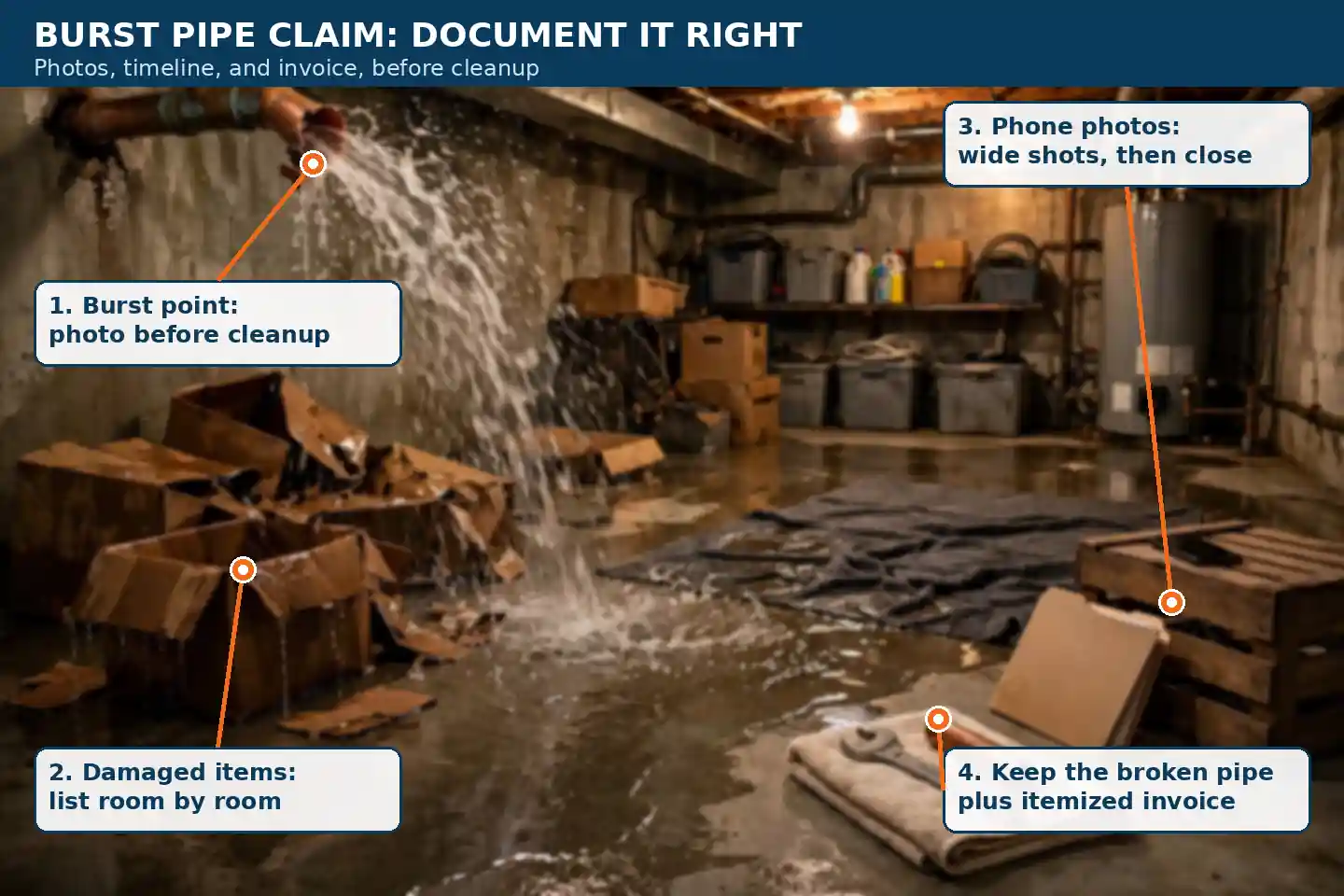
Keep the broken piece of pipe if you can. A clean split tells a different story from a corroded, thinned out section, and the adjuster may want to see it. Do not throw damaged items away until the adjuster has seen them or told you that you can dispose of them. That is also the guidance the New Jersey Department of Banking and Insurance gives to residents filing claims: photograph everything before you dispose of it, and keep the damaged property until the insurer inspects it or says you can let it go.
What Is Usually Not Covered
Knowing what is left out saves you from a nasty surprise after you file. These are the common exclusions on a standard New Jersey homeowners policy:
Flood water. A standard homeowners policy excludes water damage caused by flooding. Only separate flood insurance covers a home and personal property from floods. This is the exclusion the New Jersey Department of Banking and Insurance repeats in its claims guidance, and New Jersey insurers are required to tell you about it in writing (N.J.S.A. 17:36-5.31; N.J.A.C. 11:1-5.5). Rising water from outside, whether from a storm or an overflowing waterway, is flood water in insurance terms, even if it comes through the same basement door as a burst pipe would. If you live anywhere near a flood prone area in the Passaic area, flood cover is a separate decision to make before you ever need it.
Gradual leaks and neglect. A leak that went on for weeks or months, or damage traced to a home left without heat in winter, will usually be denied. Pipes that froze because the heat was off are a maintenance story, not a sudden accident story.
Sewer and drain backup. Water that backs up into your home through a sewer line or drain is usually a separate endorsement, not part of the base policy. If you do not have that endorsement, a backup claim will usually be denied even though the water damage looks identical to a burst pipe claim.
The pipe itself. As noted above, replacing the failed pipe is often on the homeowner, while the damage the water caused is the covered part. Ask your insurer to explain exactly where that line falls on your policy before you assume the whole job is covered.
Your policy is the contract that governs, not this post and not what a neighbor’s policy covered. Read the exclusions page of your own policy. It is dull reading, but it is the page that decides your claim.
The Documentation Checklist: What to Gather Before the Adjuster Arrives
Do these in order, as soon as it is safe to do so. You do not need fancy equipment. A phone camera and a notes app will do the job.
- Stop the water and note the time. Shut off the main water supply, then write down the time you shut it off and the time you found the water. That timeline is the backbone of a sudden damage claim.
- Photograph everything before cleanup. Take wide shots of each room, then close shots of the burst point, the wet walls and floors, and every damaged item. Take video too, walking slowly through each affected room and narrating what you see. Photograph the water line on the wall before it dries, because it fades fast.
- Keep the broken pipe and damaged items. Set the split section of pipe aside for the adjuster. Keep damaged belongings until the adjuster has seen them or told you that you can dispose of them.
- List damaged property room by room. Go room by room and write down each damaged item, with as much detail as you can: what it is, roughly when you bought it, and what it cost if you know it. If you have receipts or photos of the rooms from before the burst, those help a lot.
- Save every receipt. Keep receipts for emergency supplies, drying equipment rental, temporary repairs, and any extra living costs if you have to stay elsewhere. Keep them in one folder, paper or digital, so nothing gets lost.
- Get an itemized plumber invoice. Ask your plumber for an invoice that states what failed, where it failed, and what was done, in plain language. An invoice that says “sudden burst at a basement joint, water shut off on arrival, section replaced” supports your claim far better than one that just lists a total. Visible repair estimates from us are free, and hidden leak detection is $150 to $400, so ask what applies to your job before work starts and keep the written estimate with your claim file.
- Log every call. Write down the claim number, the name of every person you speak to, the date and time, and what they told you. Claims take weeks, and nobody remembers a phone call from three weeks ago without notes.
The New Jersey Department of Banking and Insurance gives the same core advice to residents after storm and water damage: call your insurer as soon as possible, document the damage with photos before disposing of anything, make temporary repairs to protect the property from further damage, and work with the adjuster the insurer assigns. Temporary repairs are expected of you. Permanent repairs should wait until the adjuster has seen the damage, unless waiting would cause more damage.
NJ requires plumbing work to be done by, or under the supervision of, a licensed Master Plumber.
How the Claim Process Usually Runs
The process is slower than most homeowners expect, so it helps to know the shape of it in advance.
First, you call your agent or insurer and report the loss. Have your policy number ready, and write down the claim number and the contact details for the claim representative assigned to you.
Next, the insurer assigns an adjuster, who inspects the damage and determines coverage. This inspection is the hinge of the whole claim. Be there if you can, walk them through your photos and timeline, show them the broken pipe section, and hand them a copy of the plumber invoice.
Then comes the coverage decision. If all or part of the loss is not covered, the company must explain how coverage is excluded under your policy. That is a New Jersey Department of Banking and Insurance point worth holding on to: a denial should come with a reason tied to your policy wording, not just a “no.” If the reason is that the damage was gradual, your photos, your timeline, and your plumber invoice are your answer to that finding. You can also ask about hiring a public adjuster, who is licensed by the Department of Banking and Insurance and can appraise the damage and negotiate on your behalf, though you would be responsible for their fee.
Finally, payment and repairs. Keep every receipt through the repair, because the final settlement is built on documented costs, not estimates from memory. If the settlement does not match the documented damage, ask for the decision in writing and go through it line by line against your photos and invoices before you accept it.
Common Denial Reasons, and How to Avoid Them
Most burst pipe denials come down to a handful of causes, and most of them are preventable with the checklist above.
Called gradual, not sudden. The adjuster decides the damage built up over time. Your defense is the timeline, the photos taken before cleanup, and the broken pipe section itself.
No documentation. The damage was cleaned up and repaired before anyone from the insurer saw it. Photograph first, repair second, and keep damaged items until the adjuster says otherwise.
Failure to protect the property. You knew about the water and left it running, or you did not make temporary repairs to stop further damage. Shut the water off, move belongings out of the water, and make temporary repairs promptly.
Flood exclusion. The water came from outside, not from your plumbing. This is a coverage gap, not a documentation problem, and it is fixed by separate flood insurance bought before the next storm, not by a better claim file.
Sewer backup without the endorsement. The water came up through a drain, and the policy never included backup coverage. Check your policy for a water backup endorsement now, while nothing is wrong, so you are not learning about the gap during a claim.
Late reporting. The longer the gap between the burst and the call, the harder the claim gets. Call as soon as possible, even if you do not yet know the full extent of the damage. You can add to a claim. A claim filed weeks late starts with a credibility problem.
A Note for Clifton Homeowners
Clifton homes in ZIP codes 07011 to 07014 include a lot of older housing, and older homes in the Passaic area carry older pipes. That does not change what your policy covers, but it does change what you should do before anything goes wrong. Find your main shutoff now, while the basement is dry. Take dated photos of your basement, your mechanical room, and any finished rooms once a year, so you have a “before” record if you ever need one. Check your policy for the water backup endorsement and the flood exclusion while you have time to fix any gaps. Prevention beats an argument, and a file full of photos beats a bare claim.
If a pipe has burst in your Clifton home and you need the repair documented for a claim, call us at (862) 416-0004. We will stop the water, repair the burst, and give you an itemized invoice that states what failed and what was done, so your claim file has something solid in it. For the repair itself, start with our burst pipe repair page for Clifton homeowners.
Frequently Asked Questions
Does homeowners insurance cover a burst pipe in New Jersey?
In most standard policies, yes, when the burst was sudden and accidental. The policy typically covers the damage the water caused to your home and belongings. It often does not cover replacing the worn out pipe itself, and it does not cover flood water or gradual leaks. Your own policy wording decides.
What is the difference between sudden and gradual water damage?
Sudden damage happens all at once, like a pipe splitting open. Gradual damage happens slowly over weeks or months, like a small drip behind a wall. Insurers cover sudden damage in most policies and exclude gradual damage as a maintenance issue. Photos, a written timeline, and the broken pipe section are how you show a burst was sudden.
What should I photograph after a burst pipe?
Photograph the burst point, every wet wall and floor, and every damaged item, before any cleanup. Take wide room shots and close shots, plus a slow video walk through each affected room. Photograph the water line on the wall before it dries. Keep damaged items until the adjuster has seen them or told you that you can dispose of them.
Should I repair the pipe before the adjuster visits?
Make temporary repairs to stop further damage, and that is expected of you. Wait on permanent repairs until the adjuster has seen the damage, unless waiting would cause more damage. Get an itemized plumber invoice that states what failed, where it failed, and what was done.
Why do burst pipe claims get denied?
The most common reasons are that the damage is judged gradual rather than sudden, that there is no documentation because cleanup happened before inspection, that the property was not protected from further damage, that the water was flood water or sewer backup without the right endorsement, or that the claim was reported late. A photo record, a timeline, and an itemized invoice address most of these.
What if my claim is denied in New Jersey?
Ask the insurer to explain in writing how coverage is excluded under your policy. Go through that explanation against your photos, timeline, and plumber invoice. You can also consider a public adjuster licensed by the New Jersey Department of Banking and Insurance, keeping in mind you would be responsible for their fee. The Department of Banking and Insurance is the state regulator to contact if you need guidance on the claims process.
Sources
Figures and claims guidance in this post were verified from primary sources during drafting: Insurance Information Institute, Facts and Statistics: Homeowners and renters insurance (ISO data, water damage and freezing average $15,400, 2019 to 2023), https://www.iii.org/fact-statistic/facts-statistics-homeowners-and-renters-insurance. New Jersey Department of Banking and Insurance, claims guidance for residents after storm damage, https://www.nj.gov/dobi/pressreleases/pr250718.html Policy details vary, so your own policy is the final word on your coverage.