Walk through a Clifton basement in January and you can feel the problem before you see it. The air near the foundation wall is cold, the copper feels cold, and any pipe that runs along that wall is sitting in the coldest air in the house. Insulation is the quiet fix for that. It does not heat anything. It slows heat from leaving a hot pipe and slows cold from reaching a cold one, and that extra time is often what keeps a pipe from freezing on a hard night.
This post covers the three options homeowners here actually use: foam sleeves, fiberglass wrap, and heat cable. Each one suits a different spot. Put the wrong one in the wrong place and you get little protection for your effort, so it pays to match the material to the location.
What R value means, in plain terms
R value measures how well a material resists heat moving through it. A higher R value means slower heat transfer. For pipe insulation, the number that matters is the R value of the sleeve or wrap on your pipe, not the R value printed for a wall or an attic.
The 2021 International Energy Conservation Code sets R 3 as the minimum for hot water piping. That gives you a useful floor to check against. When you shop, read the label on the exact product in your hand, because thickness and material change the number. As one example, a common 1/2 inch wall polyethylene foam sleeve from Armacell is listed at R 2.9, which shows why checking the label beats guessing from the look of the product.
For hot water pipes, insulation also pays back in comfort. The U.S. Department of Energy notes that insulated hot water pipes can deliver water 2 to 4 degrees Fahrenheit hotter at the tap than bare pipes, and can save 3% to 4% a year on water heating costs. Those are averages across homes, not a promise for one house, but they explain why this small job is worth doing even in a home that has never had a freeze.
Foam sleeves, fiberglass wrap, and heat cable compared
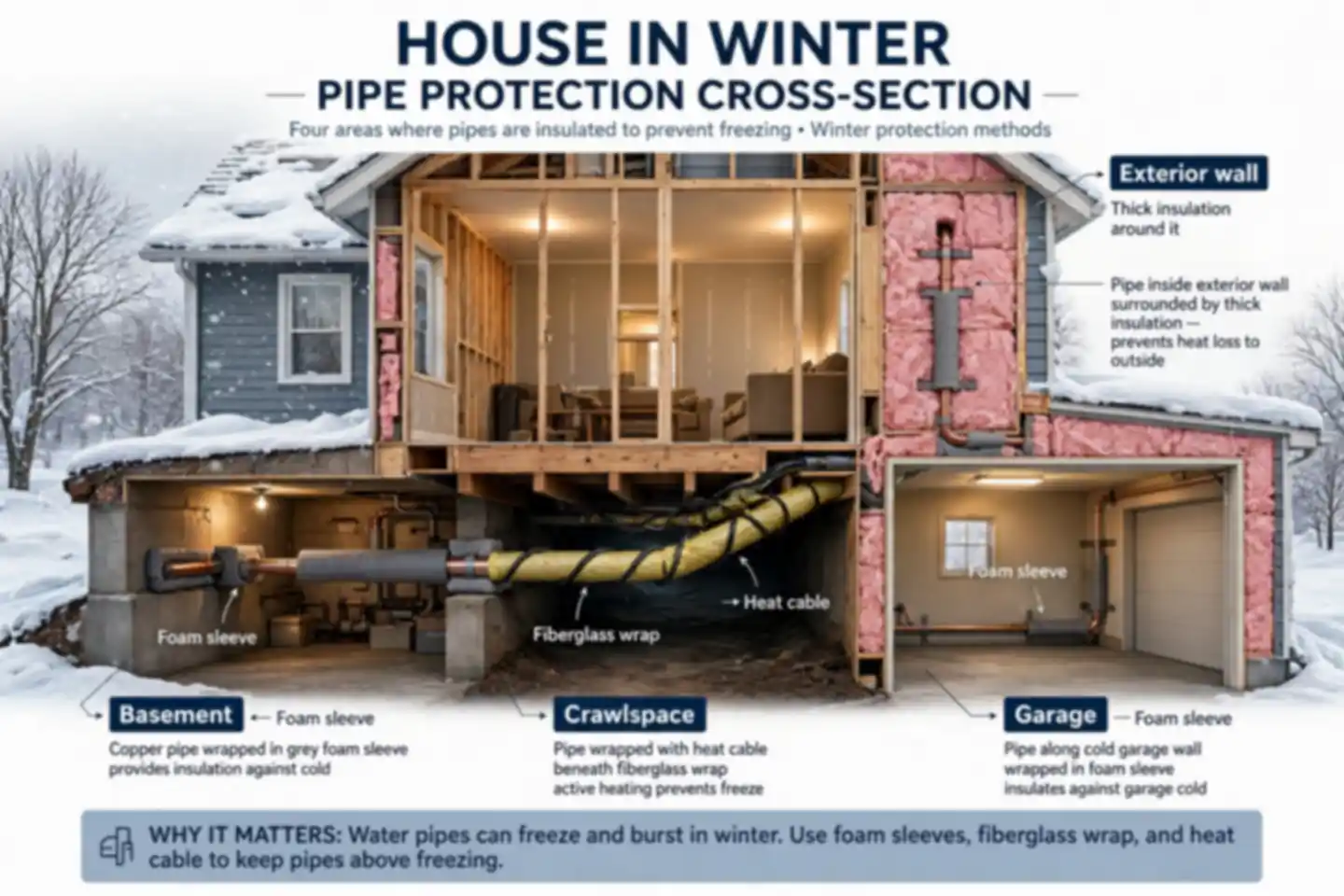
Foam sleeve. A pre slit tube that slips over the pipe and slows heat loss. It fits straight runs in basements and garages, and hot water lines. Measure the pipe first so the sleeve fits snug, and seal the seams so cold air cannot get in at the joints.
Fiberglass wrap. A wrap that goes around the pipe, often with a facing that acts as a vapor cover. It fits pipes near higher heat, and it fits over heat cable where the cable maker allows it. Keep it dry and intact, since wet or crushed wrap loses its value.
Heat cable. An electric cable that warms the pipe itself. It fits pipes in spots that stay cold even with insulation, such as a crawlspace run. It needs power, it needs the safety checks in this post, and it is not a fit and forget install.
Foam sleeves are the starting point for most homes because they are simple to fit on straight pipe and they suit hot and cold lines alike. Fiberglass wrap earns its place where heat is higher or where a sleeve cannot follow the shape of the run. Heat cable is different in kind: it adds heat rather than only slowing heat loss, which is why it helps in the coldest spots and why it carries safety rules the other two do not.
Basement: start along the foundation wall
In most Clifton homes, the basement holds long exposed runs, and the cold part of the basement is the wall itself. Pipes that run along a foundation wall, near a rim joist, or past a drafty window are the ones to cover first. Foam sleeves suit these straight runs well. Work along the full run rather than covering only the middle, and close the gaps at elbows and valves with wrap or tape made for the job, since an open joint lets cold air straight onto the bare pipe.
Also cover the hot water lines near the water heater. That is where heat loss starts, and it is where insulation gives you hotter water at the tap sooner. Leave any burner area, vent, or control on a water heater uncovered and clear, and follow the heater maker instructions for clearances.
Crawlspace: the coldest spot in many homes
A crawlspace is open to outside air in a way a basement is not, and pipes there get little shelter from wind and cold. This is the spot where insulation alone is sometimes not enough, and where heat cable enters the picture. A common setup is heat cable on the pipe with fiberglass wrap over it, but only where the cable maker allows that covering. Never guess on this point. Read the cable instructions for your exact product before you cover it.
If you go into a crawlspace to look, bring a light and check the state of what is already there. Sleeves that have slipped, wrap that has fallen, and bare patches at hangers are common, and each bare patch is a freeze point. Fix the gaps before you add anything new.
Garage: pipes on a cold wall
Garage pipes sit in a space that is rarely heated to house temperature, and the wall they run along can be nearly as cold as outside. Foam sleeves are a good fit here on straight runs. Pay attention to pipes near the garage door and any pipe that passes through the wall into the garage, since those spots see drafts as well as cold. If a garage pipe has frozen before, that history tells you insulation alone may not be enough for that run, and that is a good reason to call and talk it through rather than repeat the same fix.
Exterior walls: the hidden runs
Pipes inside an exterior wall are out of sight and easy to forget. You cannot see them, so you judge them by what happens around them: a kitchen sink on an outside wall that runs slow on cold mornings, a bathroom on an outside wall where the tap sputters in a cold snap. For these runs, the wall insulation around the pipe matters as much as anything on the pipe itself, and opening a wall to add pipe insulation is work to plan rather than rush. If you are opening a wall for a remodel, that is the time to insulate those pipes properly while access is open.
One honest limit applies everywhere in this post. Insulation slows freezing. It does not make a pipe freeze proof through sustained cold with no heat at all. In a long cold stretch, a pipe in an unheated space still needs warmth from the house, from use, or from heat cable. Anyone who tells you a sleeve alone ends freezing for good is selling you something, not explaining your pipes.
Heat cable safety: read this before you buy or plug in
Heat cable causes trouble when it is picked wrong, fitted wrong, or left unchecked. The U.S. Consumer Product Safety Commission gives clear guidance, and it is worth following in full:
Inspect heat cable once a year. If you find cracks, charring, or bare wires in the cable, replace the cable at once. Do not lap heat cable over itself unless the maker instructions for your cable permit it. Never wrap heat cable over thermal insulation that is already on the pipe. The cable goes on the pipe itself. Do not cover heat cable with insulation unless the maker advises it. Where covering is allowed, use nonflammable insulation such as fiberglass, not foam or vinyl that could catch fire from a failing cable. Use a cable rated for your pipe material, and use the proper cable for the proper pipe. Plug the 3 prong plug into a 3 prong outlet so the cable is grounded, and use a ground fault circuit interrupter outlet wherever the cable is plugged in. * Replace uncertified heat cable that is more than three years old with cable certified to a recognized standard.
If your crawlspace has no grounded, protected outlet, that is electrician work, not a reason to run an extension cord for the winter. And if an existing cable looks damaged or you are unsure what is already installed, leave it unplugged and get it checked. A cold pipe is a plumbing problem. A damaged heat cable is a fire risk.
When to do it yourself and when to call
Foam sleeves on accessible basement and garage runs are a fair do it yourself job for a homeowner who is comfortable measuring pipe and working in those spaces. The job gets harder, and the call gets wiser, when the run is in a tight crawlspace, inside a wall, near a water heater vent, or tied to a freeze that keeps coming back. A repeat freeze usually means something else is wrong: a draft, a missing section of insulation, or a run that needs heat cable and not just a sleeve. Guessing again with the same sleeve rarely fixes it.
If a pipe has already frozen, or you find a leak once it thaws, do not wait for the next cold night. Our frozen pipe page explains what to do when a pipe freezes and how we handle the repair: frozen pipe repair in Clifton. Visible repair estimates are FREE. If the problem turns out to be a hidden leak, hidden leak detection is PAID at $150 to $400. NJ requires plumbing work to be done by, or under the supervision of, a licensed Master Plumber.
For homes in Clifton, NJ 07011 to 07014, and around the Passaic area, call (862) 416-0004 and tell us which spot is giving you trouble: basement, crawlspace, garage, or an outside wall. That detail helps us point you to the right fix before the next cold stretch.
Frequently asked questions
Does pipe insulation stop pipes from freezing?
No. Insulation slows heat loss and buys time, but it does not make a pipe freeze proof in sustained cold with no heat. Pipes in unheated spaces may still need warmth from the house or from heat cable during a long cold stretch.
Should I use foam sleeves or fiberglass wrap?
Foam sleeves suit straight, accessible runs in basements and garages. Fiberglass wrap suits spots near higher heat and runs where a sleeve cannot follow the shape, and it is the covering to use over heat cable where the cable maker allows covering. Check the label R value on the exact product you buy.
Where should a Clifton homeowner start with pipe insulation?
The spots that freeze are the ones in the coldest air: basement runs along foundation walls, crawlspace runs, garage pipes on cold walls, and pipes inside exterior walls. Start with the run that has frozen before, then work through the rest of those spots.
Is heat cable safe?
Heat cable is safe when it is the right cable for the pipe, fitted per the maker instructions, plugged into a grounded ground fault protected outlet, and inspected once a year. Replace it at once if you find cracks, charring, or bare wires, and never lap it over itself or cover it unless the maker permits it.
Can I insulate hot water pipes and save money?
The U.S. Department of Energy notes that insulating hot water pipes can deliver water 2 to 4 degrees Fahrenheit hotter at the tap and save 3% to 4% a year on water heating costs. Savings vary by home, pipe length, and use, so treat those figures as averages, not a promise for one house.
What should I do if a pipe already froze last winter?
Treat that run as the priority. Check for slipped sleeves, bare patches, and drafts near it, and consider whether that spot needs heat cable rather than insulation alone. If the pipe leaked when it thawed, call (862) 416-0004 rather than waiting for the next freeze.
Sources checked for this post
U.S. Department of Energy Energy Saver guidance on insulating hot water pipes: water 2 to 4 degrees Fahrenheit hotter at the tap, 3% to 4% a year saved on water heating. 2021 International Energy Conservation Code, Section R403.5.2, hot water piping minimum R 3. Armacell Tundra polyethylene foam sleeve listing: 1/2 inch wall listed at R 2.9. New Jersey energy code county list: Passaic County in Climate Zone 5A. U.S. Consumer Product Safety Commission heat tape guidance: annual inspection, replacement on cracks or charring or bare wires, no lapping unless permitted, cable on the pipe itself, nonflammable covering only where the maker advises, grounded 3 prong plug, ground fault protection, and replacement of uncertified cable more than three years old.