You turn on a faucet on a cold morning and nothing comes out, or only a thin trickle comes out. Your first thought is probably the pipe burst. Often, in that first moment, it has not burst yet. It is frozen, and what you do next decides whether it stays a frozen pipe or becomes a flood.
This post is not a repair pitch. It is the order to follow while you wait for help. If you want the repair side of this, read our page on frozen pipe repair in Clifton. If you are standing in a cold kitchen right now, start here.
The short version
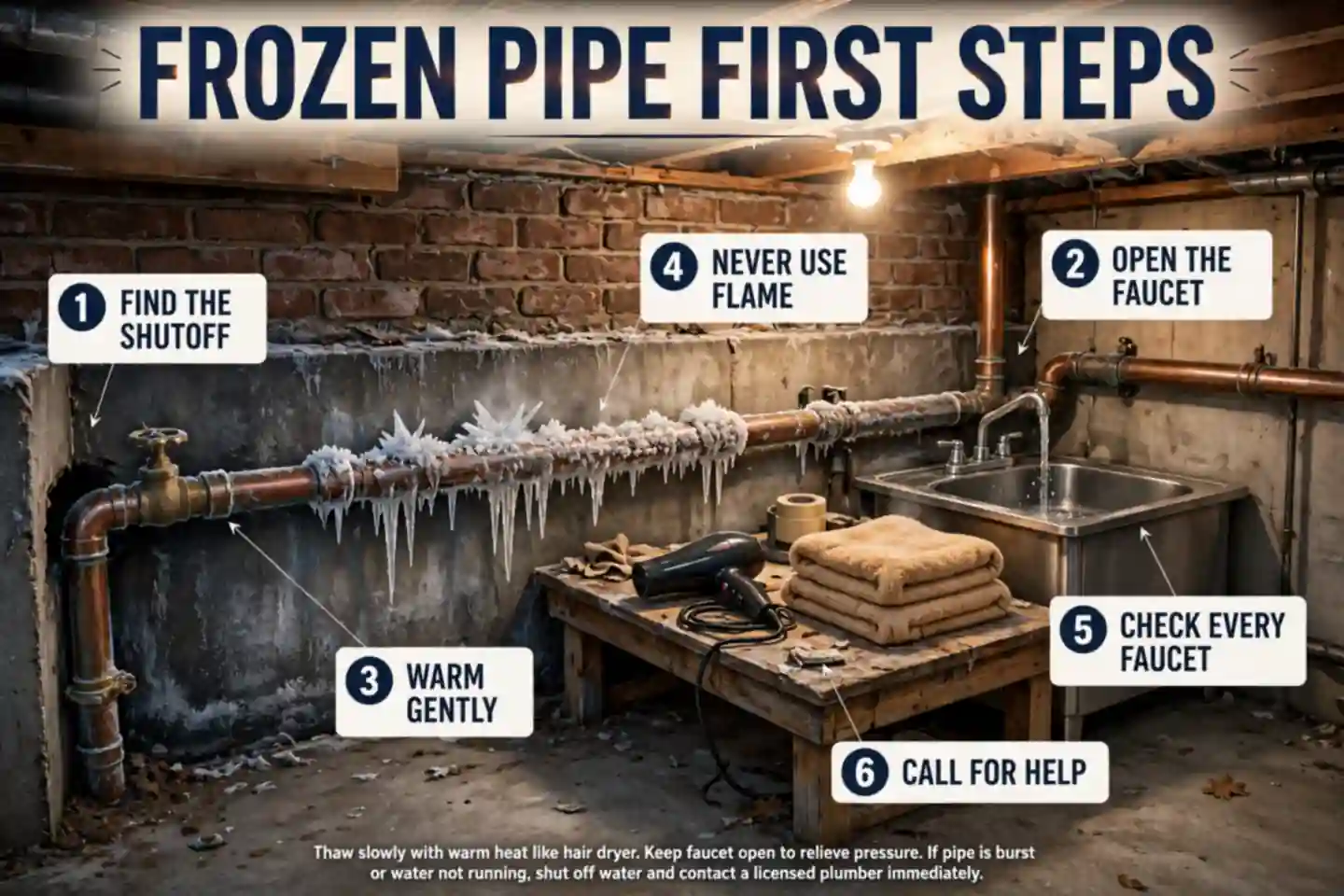
- Work out whether it is frozen or already burst.
- Find your main shutoff valve and make sure you can turn it.
- Open the faucet fed by the frozen pipe and leave it open.
- Warm the frozen section gently, working toward the open faucet.
- Check every other faucet in the house.
- Stop and call for help if you cannot find the freeze, cannot reach it, cannot thaw it, or see water where it should not be.
Call (862) 416-0004 if you are unsure at any point in that list. A short call now is better than a flooded room later.
First, frozen or burst?
Frozen and burst call for different first moves, so sort this out before you touch a heater.
Frozen looks like this. One faucet gives nothing or only a trickle, while other faucets in the house still work. The floors are dry. You may see frost on an exposed pipe in the basement, along an exterior wall, or where the water line comes in through the foundation. The American Red Cross lists those two spots, exterior walls and the service entry through the foundation, as likely places for a frozen pipe.
Burst looks like this. Water is spraying, pooling, or running inside a wall while every tap is off. A ceiling stain is growing. You hear running water when nothing is on. If you see any of that, skip the thawing steps. Shut off the water at the main valve first, then call (862) 416-0004. Thawing a pipe that already split only lets more water out.
If no faucet in the house has water at all, do not assume a freeze right away. The problem may be on the supply side. Call before you start warming pipes.
Step 1: Find the main shutoff and check that it turns
In many Clifton homes the main shutoff is in the basement, near where the water line enters through the foundation wall, often close to the meter. Go and look at it now, before you need it in a panic. Turn it a little to check that it moves, then turn it back to where it was.
If water is already flowing where it should not be, turn the main shutoff off and leave it off until a plumber has seen the pipe. If the valve is stuck, do not force it with a wrench until something snaps, and do not go digging outside for a street valve. Call (862) 416-0004 and say the valve is stuck. A stuck valve is a common find on a cold morning, and it is better found now than found while water is running.
Knowing where this valve is, and knowing it turns, is a useful thing to have sorted before anything else in this post.
Step 2: Open the dead faucet and leave it open
Open the faucet fed by the frozen pipe. Leave it open while you work. The American Red Cross gives this as the first thawing step for a clear reason. As the frozen section starts to melt, water needs somewhere to go. Running water through the pipe also helps melt the rest of the ice.
Do not open the main valve all at once to force pressure through a frozen line. A frozen pipe bursts when pressure gets trapped, not when cold alone touches it. Keep the faucet open, let pressure escape forward, and bring the water back gently once the line is flowing again.
Step 3: Warm the frozen section gently
Once the faucet is open, apply gentle heat to the frozen section. The American Red Cross lists four options: an electric heating pad wrapped around the pipe, an electric hair dryer, a portable space heater kept away from flammable materials, or towels soaked in hot water wrapped around the pipe.
Work toward the open faucet. Start near the faucet and move back along the pipe toward the ice. That way meltwater and pressure escape forward through the open tap instead of building up behind the ice.
Keep the heat moving and stay with it while it is on. Do not park a dryer in one spot, do not leave a heater running in a room you have left, and do not pile towels over a heater. Keep heating until full water pressure returns. If pressure comes back and then drops again, or if flow stays weak, the freeze may run further along the line than you can see.
This is also the point to be honest about reach. If the frozen section is inside a wall, under a floor, or in a spot you cannot get to safely, stop. The American Red Cross says the same: if you cannot locate the frozen area, if it is not accessible, or if you cannot thaw the pipe, call a licensed plumber.
Step 4: What not to do
Three mistakes turn a frozen pipe into a burst pipe or a fire, and all three happen when people are in a rush.
Do not use an open flame. No blowtorch, no kerosene heater, no propane heater, no charcoal stove, and no other open flame device near a pipe. Pipes run through framing, insulation, and drywall, and a torch near those materials is a fire risk. Gentle heat is the whole method. There is no faster version of it that stays safe.
Do not blast one spot with high heat. A hair dryer held in one place, or a heater pressed close to the pipe, heats unevenly and can damage the pipe or what sits around it. Keep the heat gentle, keep it moving, and give the ice time to melt.
Do not put antifreeze in a water line unless you have been directed to do so for that line. The American Red Cross warns that antifreeze is harmful to people, pets, wildlife, and landscaping. It is not a thawing shortcut.
Do not wait and hope it fixes itself while the faucet stays closed. A closed faucet traps pressure behind the ice. Open the faucet, start gentle heat, and if nothing changes, call. Waiting with a closed tap is the quiet way a freeze becomes a burst.
Step 5: Check every other faucet
If one pipe froze, others may have frozen too. The American Red Cross makes this point plainly, and it matches what cold mornings in the Passaic area actually look like. Walk the house and try each faucet, including sinks on exterior walls and any tap fed by a line in an unheated space.
Note which faucets are dead and which work. That list is useful on the phone. It tells a plumber whether the freeze sits in one branch line or further back toward the main supply, and it saves guessing once someone arrives.
While you walk the house, look for water where it should not be, especially under sinks, around the base of walls, and on ceilings below bathrooms. If you find any, go back to step 1, shut the main valve off, and call (862) 416-0004.
Step 6: When to stop and call
Call if any of these are true:
You cannot find the frozen section. You found it but cannot reach it safely. You warmed it gently and it will not thaw. Flow came back, then stopped again. You see a split, a crack, or water leaking from the pipe. Water is running inside a wall or pooling on a floor. * The main shutoff is stuck and you need the water off.
When you call, say three things: which faucets are dead, whether you see frost on any exposed pipe, and whether any water is showing where it should not be. That is enough for a plumber to judge how urgent the visit is and what to bring.
Call (862) 416-0004 for homes in Clifton, 07011 to 07014. An estimate for a visible repair is free. Hidden leak detection is a paid visit, $150 to $400. Typical ranges. Your final price is confirmed in writing before any work starts.
While you wait for help
If the pipe is frozen but not leaking, leave the dead faucet open, keep the room warm, and keep cabinet doors under sinks on exterior walls open so warm air can reach the plumbing. The American Red Cross lists open cabinet doors and a steady thermostat as cold weather habits, and both help while you wait.
If a pipe has split, keep the main valve off, move rugs, boxes, and anything that soaks up water away from the wet area, and take photos of the split and the water before cleanup. Photos help later when you describe what happened, and they cost nothing to take.
If you are leaving the house during cold weather, the American Red Cross advises leaving the heat on, set to no lower than 55 degrees. A house that goes cold while you are away is a house where a small freeze can sit unnoticed and turn into a large leak.
A short note on NJ rules
New Jersey plumbing work sits under the state Uniform Construction Code, and the plumbing subcode includes a section on freezing and overheating. One NJ amendment in that section covers buried combined domestic and fire service piping: the minimum earth cover is 42 inches, or the top of the pipe sits 12 inches below the frost depth of the locality, whichever is greater. That rule is about how deep a buried service line goes, not about what you do at the kitchen sink on a cold morning. It is worth knowing because it explains why a buried line and an exposed basement run are different problems. The basement run is the one you can see, open a faucet for, and warm gently. The buried line is not a homeowner thawing job.
NJ requires plumbing work to be done by, or under the supervision of, a licensed Master Plumber.
What to do next time, before the freeze
Once the water is flowing again, do the calm version of this post. Find the shutoff on a normal day and check that it turns. Insulate exposed runs in the basement and in any unheated space you can reach. In very cold weather, let cold water drip from a faucet served by exposed pipes, since running water through the pipe, even at a trickle, helps prevent freezing. Keep the thermostat steady day and night during a cold spell instead of dropping it low overnight.
None of that needs to happen in the first 30 minutes. In the first 30 minutes, the job is smaller: open the faucet, find the shutoff, warm gently, check the rest of the house, and call early if anything looks wrong. Do those things in that order and a frozen pipe has a much better chance of staying just a frozen pipe.
If you need the repair side of this, our page on frozen pipe repair in Clifton covers thawing, split checks, and pricing. If you need help right now, call (862) 416-0004.
Frozen Pipe First Response FAQs
Can I thaw a frozen pipe myself?
Yes, if the frozen section is exposed and reachable, and the pipe has not split. Open the faucet fed by that pipe, leave it open, and warm the section gently with a heating pad, a hair dryer, a space heater kept away from flammable materials, or towels soaked in hot water. Work toward the open faucet and keep heating until full pressure returns. If you cannot find the freeze, cannot reach it, or cannot thaw it, call a licensed plumber.
What should I never use to thaw a pipe?
Never use a blowtorch, a kerosene heater, a propane heater, a charcoal stove, or any other open flame device. The American Red Cross warns against all of them for thawing. Pipes run near framing and insulation, and open flame near those materials is a fire risk. Gentle heat only, and stay with it while it is on.
Should I shut off the water if a pipe is frozen but not leaking?
Not always, but know where the shutoff is and check that it turns. If the pipe is frozen, dry, and you are thawing it gently with the faucet open, the water can stay on. Shut the main valve off right away if water appears where it should not be, if you see a split, or if you hear running water inside a wall with every tap off. If the valve is stuck, call rather than forcing it.
How do I know if the pipe burst while it was frozen?
Look for water where it should not be: spraying, pooling, a growing ceiling stain, or the sound of running water inside a wall when every tap is off. A frozen pipe alone gives no water or only a trickle from one faucet, with dry floors. A burst pipe gives water in the wrong place. If you see the burst signs, shut the main valve off first, then call.
Why keep the faucet open while thawing?
Because melting ice needs somewhere to go. With the faucet open, water can flow through the frozen area as it melts, and that running water helps melt the rest of the ice. With the faucet closed, pressure builds behind the ice plug, and trapped pressure is what splits a pipe. Keep the faucet open from the start of thawing until full pressure returns.
What if no faucet in the house has water?
Do not assume a freeze right away. A whole house loss of water may be a supply problem rather than one frozen branch line. Call (862) 416-0004 and describe what you found, including whether it is a cold morning and whether neighbors have water. A plumber can help sort out whether the problem sits inside your home or further back on the supply side.
Sources used for this post: American Red Cross frozen pipe guidance, including thawing steps and cold weather habits; New Jersey Administrative Code Title 5, Chapter 23, Subchapter 3, Section 5:23-3.15, plumbing subcode, Section 2.16 on freezing and overheating; Passaic Valley Water Commission, named as the Clifton water provider, with no street shutoff process claimed in this post.